In brief
- The first line is the market and the direction: a buy gains if price rises, a sell if it falls.
- The entry is where to get in; "(market)" means at the current price, now.
- The stop loss is where the trade is wrong. It goes on with the trade, never after.
- The take-profit targets, TP1 to TP4, are where to take profit, nearest first.
- Size the trade from the stop: decide what a loss may cost, then work out the lots.
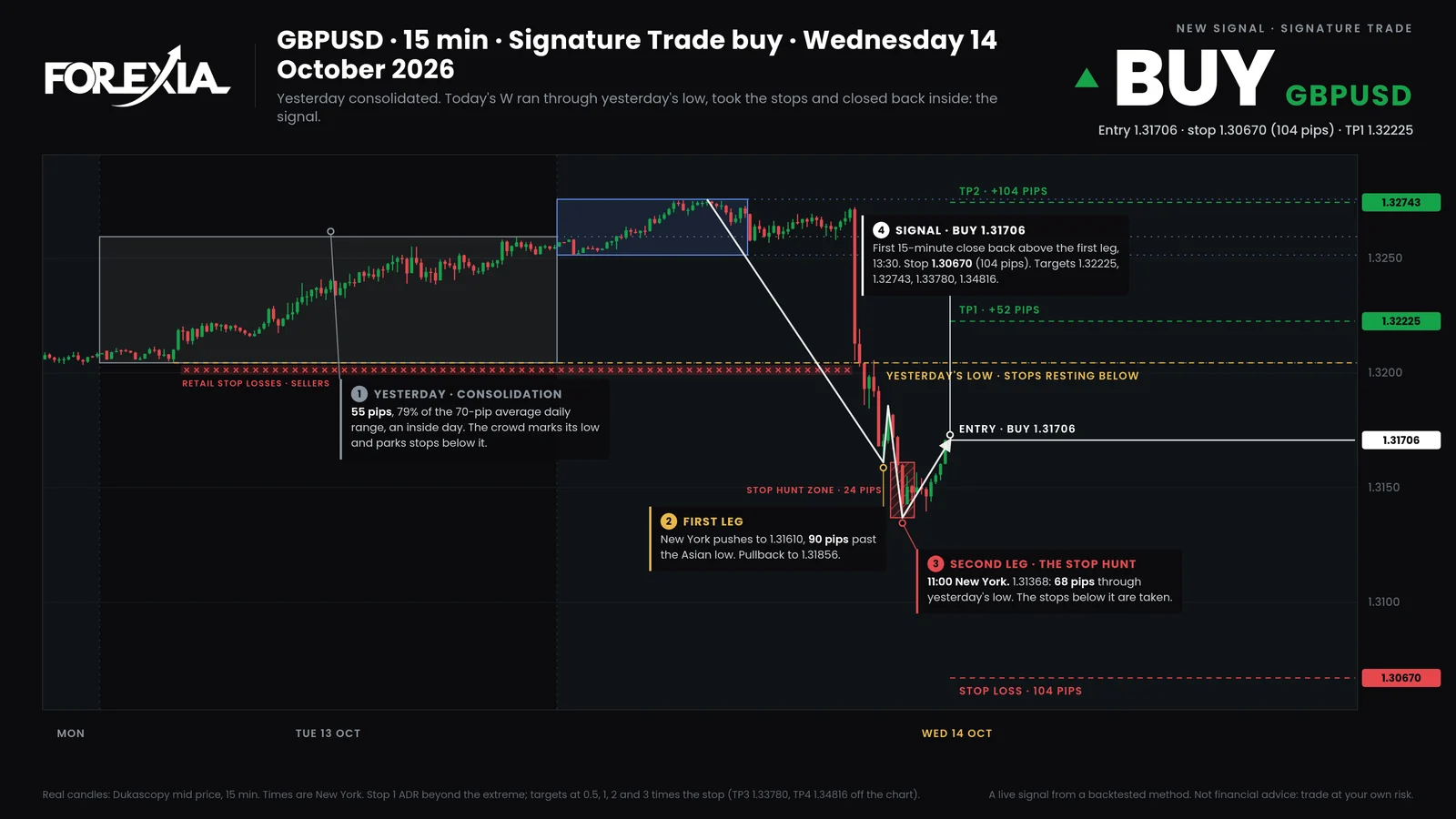
Every forex signal says the same few things, in different orders and with different words. This post reads one our bot posted to the free Telegram channel, line by line: the GBPUSD buy of 14 October 2026, the chart at the top of this page. Open · TP3 reached so far.
One signal, line by line
The chart came as the photo, and the caption opened like this:
🟢 BUY GBPUSD · Signature Trade Entry: 1.31706 (market) Stop: 1.30670 (104 pips) TP1: 1.32225 (+52 pips) TP2: 1.32743 (+104 pips) TP3: 1.33780 (+207 pips) TP4: 1.34816 (+311 pips)
- 🟢 BUY GBPUSD · Signature Trade. The market (British pound / US dollar), the direction, and the setup that fired it, explained in How it works. On a buy you profit if GBPUSD rises; on a sell, if it falls.
- Entry: 1.31706 (market). Where the trade starts. "(market)" means at the price when it was posted: you get that price or close to it if you act at once, a little worse after the spread and any delay.
- Stop: 1.30670 (104 pips). The stop loss, under the entry for a buy: if price gets there, the setup has failed and the trade closes at a loss. The pips in brackets are its distance from the entry.
- TP1 to TP4. The take-profit targets, each further away. Measured against the stop, these were 0.5, 1, 2, 3 times its distance: TP1 is the nearest and the likeliest to be reached, the last the furthest.
What a pip is
A pip is the unit the distances are counted in. On most pairs it is the fourth decimal, 0.0001; on pairs quoted in yen it is the second, 0.01. On this GBPUSD signal the entry was 1.31706 and the stop 1.30670: 0.01036 apart, which is 104 pips. On gold our bot counts a dollar as a pip; brokers count gold differently, so check how yours does before you size a gold trade.
Size the trade from the stop
The stop tells you how far price can go against you. Your size decides what that costs. Work it out in this order:
- Decide what a loss may cost: a fixed share of the account. Many traders use 1% or less.
- Find what one pip is worth on one lot. A standard lot is 100,000 units of the first currency (1.00 lots), a mini lot 10,000 (0.10) and a micro lot 1,000 (0.01). On pairs quoted in dollars, such as EURUSD and GBPUSD, a pip on a standard lot is worth $10; on the others it is worth 10 units of the second currency, turned into dollars at the current price.
- Divide: the loss you allow, over the stop in pips times the value of a pip.
On this signal, with a $10,000 account risking 1% ($100): the stop was 104 pips and a pip on a standard lot is worth $10, so one standard lot would have risked $1,040. $100 ÷ $1,040 is 0.096 lots; rounded down, 0.09 lots, which risks $93.60 if the stop is hit. Round down, never up: the stop is the most a trade should cost, and slippage can add to it.
Decide what you do at each target
Four targets do not mean four trades. They are four places to take profit, and what you do at each is a decision to make before you enter, not when price is at TP1. Common ways:
- Close a part at each target, for example a quarter at each, so every target reached banks something.
- Hold for one target you choose in advance, and close the whole trade there.
- Hold the whole position to the last target or the stop, which is how our bot counts: hands off, the stop never moved.
The choice changes what a signal is worth to you. A signal that reaches TP1 and then comes back to the stop is a gain if you closed part at TP1, and the full stop if you held everything. Our record shows that case as "TP1, then the stop", and How we count explains why it counts the furthest target.
When you see a signal late
A market entry is the price at the moment it was posted. If you open the channel an hour later, price may be closer to TP1 and further from the stop, and the trade is no longer the one in the message: less to gain and more to lose. Before taking a late signal, check where price is now against the entry, and read the replies: if TP1 has already been posted, the trade you would be taking is a different one. Many traders set a rule, such as skipping any signal that has already moved a set share of the way to TP1.
Read the replies
A signal is followed in its own thread. Each target, and the stop, comes as a reply to the signal with the chart redrawn, so the whole trade reads top to bottom. This one has 3 replies so far:
- Wed 14 Oct, 19:40. TP1 hit: 1.32225 (+52 pips).
- Thu 15 Oct, 05:40. TP2 hit: 1.32743 (+104 pips).
- Tue 20 Oct, 09:20. TP3 hit: 1.33780 (+207 pips).
How a bot posts and threads them is in How to add a bot to a Telegram channel.
Mistakes that cost more than a bad signal
- Entering without the stop, meaning to add it later, or moving it further away when price nears it. The stop is what made the size safe.
- Sizing by feel. The same lot size on a 30-pip stop and a 100-pip stop is two very different risks.
- Taking the same trade twice. Two channels that both say buy GBPUSD are one trade with double the risk.
- Trading from a screenshot or a forwarded message, without the time it was posted.
- Judging a channel by one signal. Read its record: how to check one.