Rules, not a black box
How the bot works
Two setups, written down as rules a program can apply, and eight checks listed on every signal. The same candles always give the same signal.
Every five minutes
- It brings the eight markets' candles up to date and keeps only 15-minute candles that have closed.
- Once a week, after the Friday release, it reads the new COT report.
- It runs its two setups over the candles.
- For each new signal it draws the chart and posts it with the entry, the stop and four targets.
- For each signal already posted, it replies when a target is reached, when the stop is hit, or when ten trading days run out, with the chart redrawn.
It runs from Sunday evening to Friday evening, New York time. When the market is shut it does nothing; open signals carry on when it reopens.
The Signature Trade
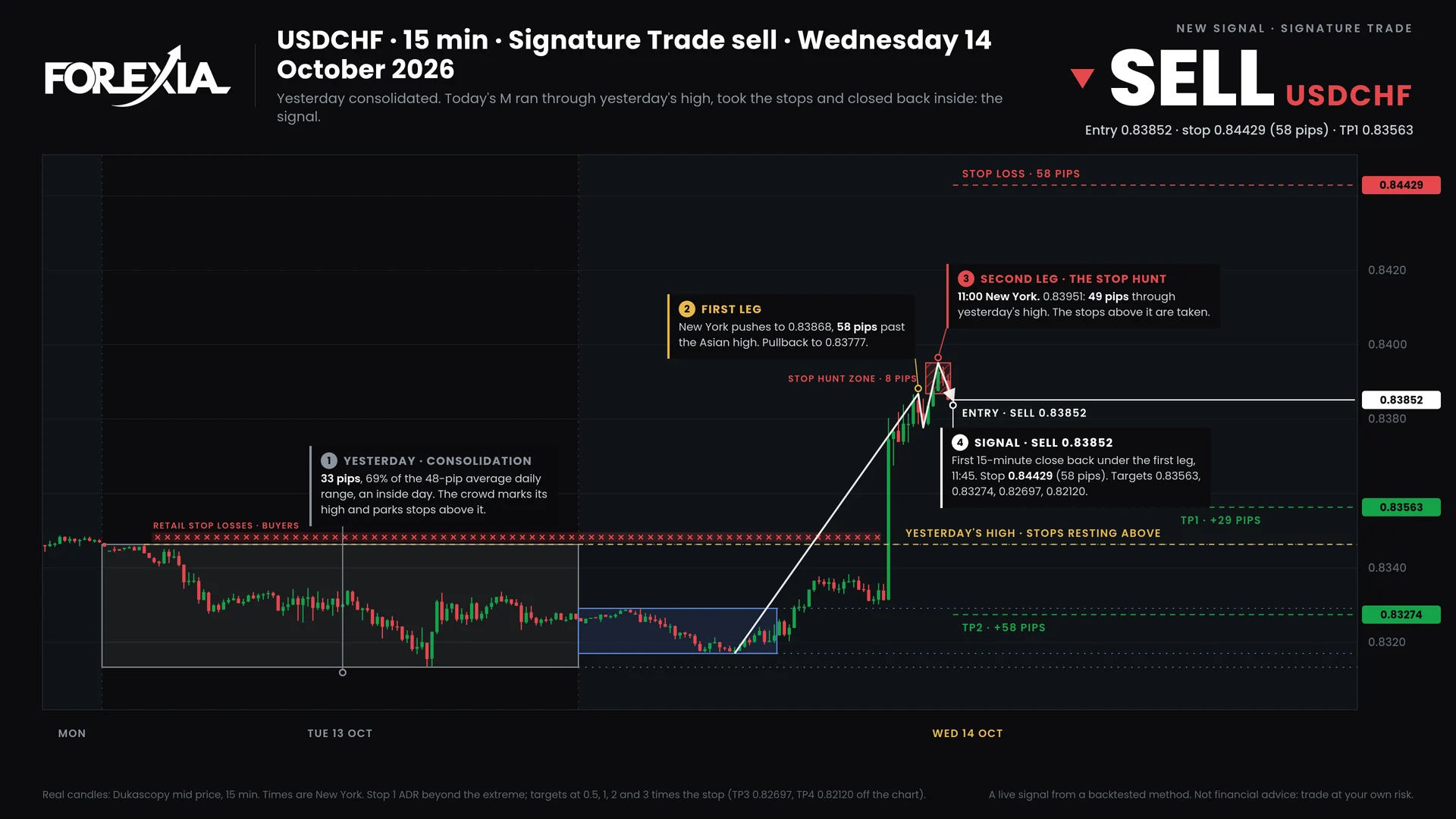
The bot's main setup: a second-leg stop hunt after a quiet day.
- Yesterday was quiet: its range was no more than 60% of the average daily range, or it was an inside day. The crowd marks its high and low and parks stops past them.
- The Asian range sets the night's high and low, from 17:00 to 03:00 New York.
- London or New York pushes through one side: a first leg. Price pulls back at least 15% of an average daily range.
- A second leg goes at least 6% of an average daily range past the first, takes the stops the first leg left and yesterday's high or low, and fails, at least 20% of an average daily range past the Asian range. That is the stop hunt, and it draws an M off a high or a W off a low.
- The first 15-minute candle that closes back past the first leg is the close back. The bot posts the signal then, at the market price.
It looks for this from Monday to Thursday, and allows up to three Signature Trades open in the same direction at once.
The COT level hunt
The second setup trades against a crowd. The COT report shows how the large speculators are positioned in each currency's futures. The bot reads their position against its own three-year range, from 0 to 100.
- The large speculators are crowded against the trade: 80 or more on that scale.
- A stop hunt takes a prior level in the crowd's direction: the previous day's, week's or month's high or low.
- The close back fires the signal, against the crowd.
Only one COT level hunt is open at a time. Testing found that trading with a crowded position did worse than fading it, which is why the setup never goes with the crowd.
Entry, stop and targets
- Entry: the market price at the close back.
- Stop: one average daily range beyond the extreme of the hunt, using the range as it stands that day.
- Targets: half, one, two and three times the stop.
On the USDCHF sell above: entry 0.83852, stop 0.84429 (58 pips), targets 0.83563 (+29), 0.83274 (+58), 0.82697 (+115), 0.82120 (+173).
The eight checks
Every signal lists eight checks, each passed or not, with the facts from the candles. They say how clean the setup was; a signal does not need all eight. They are the method's confirmations, shown so you can judge each signal for yourself.
| Check | Passed when |
|---|---|
| Clear Asian range | The Asian range is no more than 60% of the average daily range, and did not drift to close near one end. |
| Second-leg stop hunt (M or W) | A first leg went through the level, pulled back, and a second leg went further: an M off a high, a W off a low. |
| Hunt at a session open | The extreme printed in the first 90 minutes of London or the first two hours of New York. |
| Yesterday's high or low taken | The hunt went through yesterday's high (for a sell) or low (for a buy), which the Asian session had not already taken. |
| High-impact news in sync | A high-impact release for either currency came in the extreme's 15-minute candle or the one either side. |
| Tuesday or Wednesday | It formed on a Tuesday or Wednesday, when the method expects the week's high or low. |
| High or low of the week | The extreme is the high (or low) of the week so far, from Tuesday on. |
| Induced from the week's open | The extreme sits at least half an average daily range from the week's open, in the direction of the hunt: the crowd was led there. |
When they apply, it also notes: yesterday consolidated (for the Signature Trade: yesterday's range, and whether it was an inside day); deep hunt (the hunt ran 35% of an average daily range or more past the Asian range); average daily range used up (the day had already travelled a full average daily range when the extreme printed); other dollar pairs hunted the same way (at least two other dollar pairs made a fresh extreme of the day the same way for the dollar in the hour before).
Following a signal
Nothing is managed. The stop never moves; the bot follows the whole signal to the fourth target, the stop, or the end of the tenth trading day, when it closes at the market at ten to five New York. At each target and at the end it replies to its own post with the chart redrawn. Its messages count a signal at the furthest target it reached; how we count says what that means for a signal that then hit its stop.
Where signals go
Every signal goes to the paid channel, for ForexiaPRO members. The free channel gets up to six a month: the allowance grows by one about every five days, and a signal goes free if there is room when it is posted, before its result is known. Updates go to every channel the signal was posted in.
The data
Bid and ask prices from Dukascopy, in 5-minute candles turned into 15-minute ones; the CFTC's Commitments of Traders report; and a calendar of high-impact releases. Your broker's prices and spreads will differ a little, and so will your fills.
What rules do not do
Rules make every signal checkable; they do not make it right. Most stop hunts the bot trades do not reach the fourth target, and some reach the stop first. The record shows how each one ended, and past signals do not tell you what the next one will do.
Questions
Is the bot AI?
No. It applies written rules to 15-minute candles. The same candles always give the same signal, and every signal lists the checks behind it.
How many signals does it send?
As many as the rules find. Across the eight markets that has been about eleven a month in testing; the free channel gets up to six of them.
Why does every signal have four targets?
So a trader can choose how to take profit. The targets are half, one, two and three times the stop. The bot itself is hands off: the stop never moves, and it follows the signal to the fourth target, the stop or ten trading days.