Glossary
Average daily range (ADR)
How far a market typically travels from its low to its high in one trading day. The bot measures every distance in it: how deep a hunt went, how far its stop sits, how much of the day is already used up.
The figures
The average daily range is the mean of each day's high minus its low. The bot's day runs from 17:00 to 17:00 New York. Over the period measured:
| Market | ADR | Median day | Average weekly range | Week as ADRs |
|---|---|---|---|---|
| EURUSD | 75 | 67 | 168 | 2.2 |
| GBPUSD | 96 | 85 | 215 | 2.2 |
| USDJPY | 118 | 101 | 274 | 2.3 |
| USDCHF | 65 | 58 | 147 | 2.3 |
| AUDUSD | 66 | 59 | 146 | 2.2 |
| USDCAD | 78 | 70 | 176 | 2.3 |
| NZDUSD | 61 | 55 | 136 | 2.2 |
| XAUUSD | 45 | 30 | 100 | 2.2 |
The average sits above the median on every market because a few very large days pull it up. A week covers about 2.2 average days, not five: most days give back part of what the day before did.
How the bot uses it
- The stop. One average daily range beyond the extreme of the hunt. A stop measured in ADR is as wide on a quiet pair as on a fast one, in proportion.
- The targets. Half, one, two and three times the stop.
- The checks. A clear Asian range is at most 60% of the ADR. A deep hunt is one that ran 35% of it past the range. "Average daily range used up" means the day had already travelled a full ADR when the hunt printed: the move was spent.
The bot uses the range as it stands on the day of the signal, not these long-run averages. On the USDCHF signal of 14 October 2026 it read the average daily range as 48 pips, against 65 over the whole period.
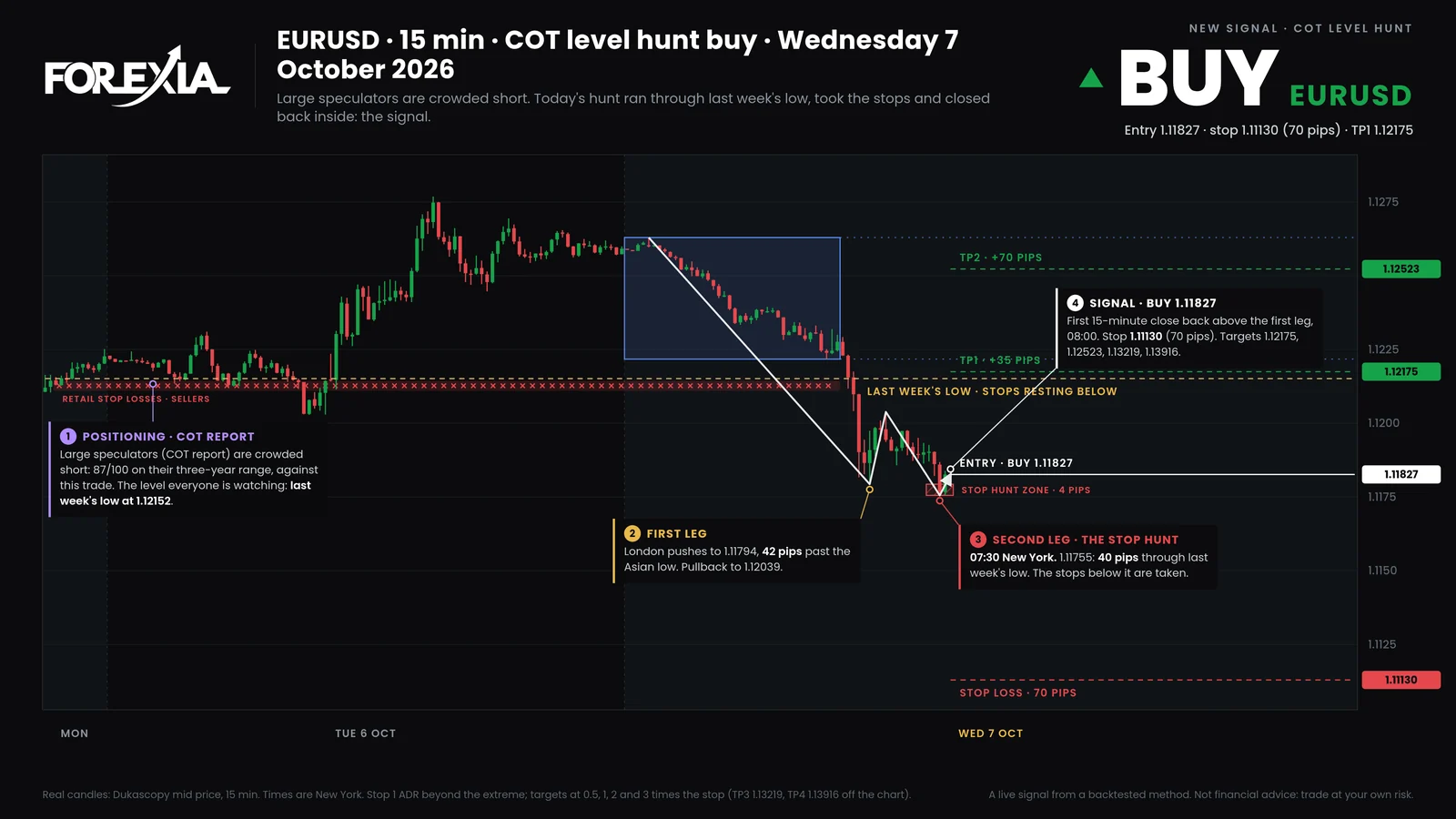
In the record: EURUSD buy, 7 October 2026, USDCHF sell, 14 October 2026, GBPUSD buy, 14 October 2026.
Questions
How do I calculate the average daily range?
Take each day's high minus its low over a number of days and average them. Fourteen or twenty days is common for a current figure; the table above averages almost six years to show each market's character.
Which forex pair moves the most in a day?
Of the seven dollar majors, USDJPY, at 118 pips a day on average over the period, then GBPUSD at 96. NZDUSD moves least, at 61.