Glossary
Stop hunt (liquidity sweep)
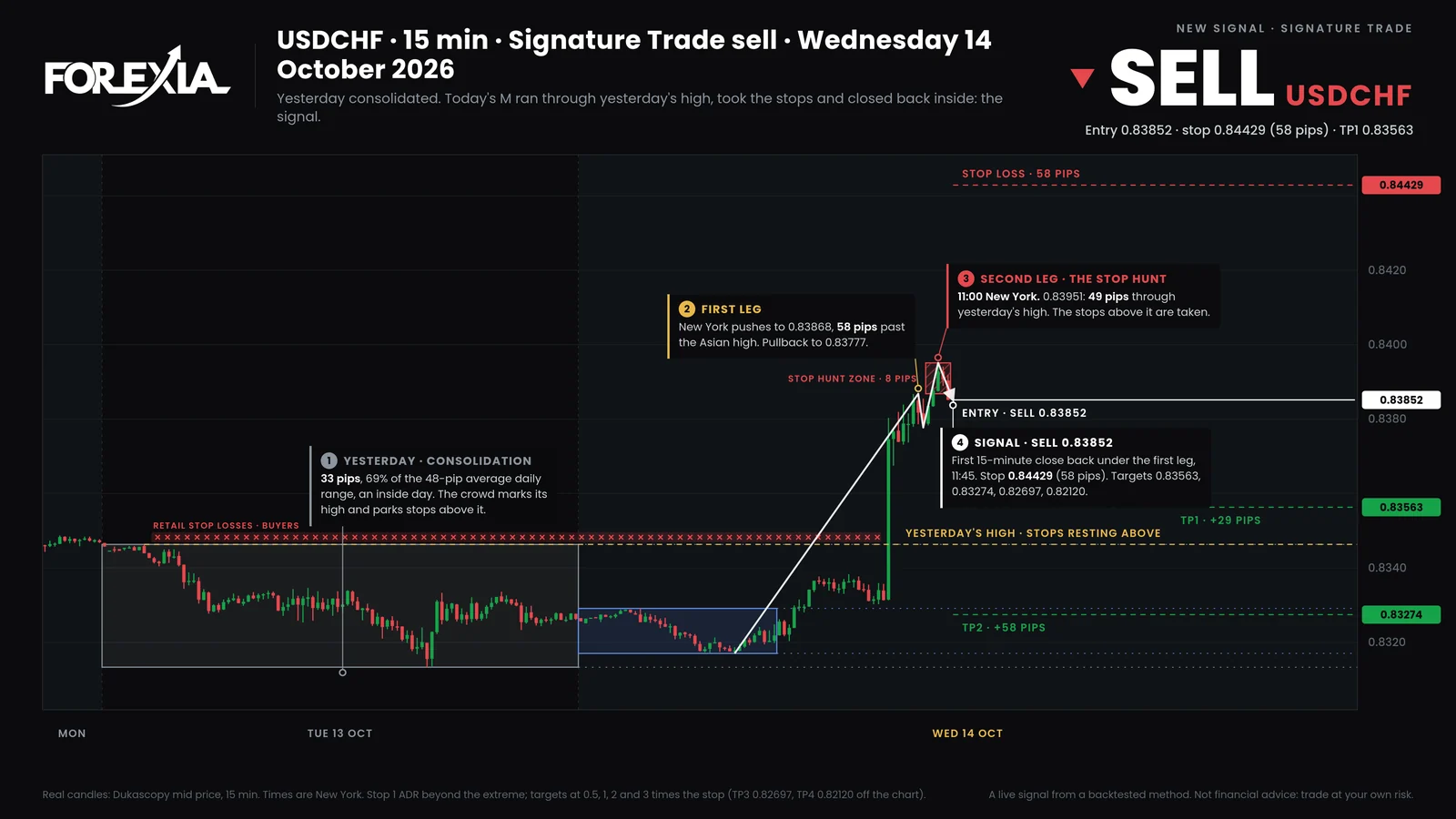
A push through a level where many traders keep their stop orders, which takes those orders and then fails, coming back inside. Traders also call it a liquidity sweep. It is the move every signal of the bot starts from.
Why stops sit where they do
Most traders put their stop just past an obvious level: above yesterday's high when they sell, below the Asian session's low when they buy. A breakout trader puts a buy order in the same place. So a level everyone can see is a level with a cluster of orders resting just past it.
When price pushes through, those orders fill at once. Stops on short trades are buy orders, so a push above a high fills a wave of buying; whoever wanted to sell size gets it there. If nothing else is driving price on, the push fails and price closes back inside. That failed push is the stop hunt. Smart money did not have to see anyone's stop; it only had to know where the crowd keeps them.
How the bot defines one
The bot needs a rule a program can apply, so its definition is exact: in London or New York, price makes a new high or low of the day beyond the Asian range, then a 15-minute candle closes back inside the level it went through. That close is the close back, and it is the signal's entry.
The measured profiles below use a stricter definition, known only once the day is over: the day's high or low prints in London or New York beyond the Asian range, then price reverses at least 0.4 of the average daily range back inside the range.
How far a stop hunt goes
Across the eight markets the bot reads, a stop hunt runs a median of about 23% of an average daily range past the Asian range, and one in ten runs past about half of it. In pips it depends on the market:
| Market | Hunts a week | Median depth | Middle half | 1 in 10 beyond | Median reversal |
|---|---|---|---|---|---|
| EURUSD | 3.2 | 16 | 9 to 28 | 43 | 54 |
| GBPUSD | 3.3 | 21 | 11 to 35 | 50 | 68 |
| USDJPY | 2.3 | 21 | 11 to 39 | 62 | 74 |
| USDCHF | 3.4 | 14 | 7 to 23 | 35 | 46 |
| AUDUSD | 2.5 | 13 | 7 to 23 | 34 | 46 |
| USDCAD | 3.4 | 18 | 9 to 29 | 42 | 57 |
| NZDUSD | 2.6 | 13 | 6 to 21 | 32 | 41 |
| XAUUSD | 2.9 | 7 | 3 to 12 | 21 | 22 |
Two things follow. A stop placed a few pips past the Asian range is inside the typical hunt, which is why it gets taken. And most breaks of the range are not hunts at all: on every market, between 41% and 51% of breaks turned into one. The rest kept going. That is why the bot waits for the close back instead of fading the first spike.
When stop hunts happen
On every one of the eight markets, the busiest hour for a stop hunt is 08:00 New York, the hour of the US data releases and the run into the New York open. The bot's check "Hunt at a session open" asks whether the extreme printed in the first 90 minutes of London or the first two hours of New York.
A stop hunt is not a signal by itself
The bot needs more than a hunt: one of its two setups, a second-leg M or W or a hunt of a prior level against a crowded COT position, then the close back. Its checks then say how clean the setup was. How the bot works.
Questions
Is a stop hunt the same as a liquidity sweep?
Yes. Both name a push through a level that takes the orders resting past it and then fails. "Liquidity" is the orders; "sweep" and "hunt" are what price does to them.
Who hunts stops?
Nobody needs to see your stop to take it. Large traders who need to fill size look for it where it is: the orders resting past an obvious level. When price reaches them, the stops become the other side of the large trader's order.
How do I avoid being stop hunted?
Do not put your stop where everyone else puts theirs. On EURUSD a stop hunt runs a median 16 pips past the Asian range; a stop a few pips past it is inside the typical hunt. The bot places its stop one average daily range beyond the extreme of the hunt.