Strategy template · early access
Judas swing strategy, automated
A candle runs through the Asian range early in London, then a 15-minute candle closes back inside it: that close is the signal. The bot runs it on real candles, draws each signal and posts it to your Telegram channel, built with you in early access.
What the judas swing is
A Judas swing is a false move at the start of a session: price runs through the quiet Asian range, drawing in traders who see a breakout, then turns and runs the other way. The name comes from the idea that the first move betrays the traders who follow it. It is one of the concept setups taught in the "market maker" school of trading.
The rules leave out the story and keep the clock: a range from 19:00 to 00:00 New York, a run through one side of it in a set window, and a close back inside. That is what a bot can test, candle by candle.
The bot's rules
- The Asian range is the high and low from 19:00 to 00:00 New York, built from 20 15-minute candles. A range with a candle missing is skipped.
- From 00:00 to 05:00 New York, a candle trades beyond the range: above its high sets up a sell, below its low a buy.
- If a 15-minute candle then closes back inside the range before 07:00 New York, the bot signals at that close. The first setup of the day only.
- Stop beyond the swing's furthest price plus 0.1 × ATR(14). Targets at 1, 2, 3 times the stop distance.
Which version. The false-move version, as commonly taught: the Asian range from 19:00 to 00:00 New York, a run through it between 00:00 and 05:00 New York, and a close back inside before 07:00 New York.
The settings
The defaults the example was found with. Each one is a setting, not a rewrite.
| Setting | Default | What you can change |
|---|---|---|
| Market | XAUUSD | Gold or any of the seven US-dollar majors; other markets need a price feed first. |
| Candles | 15 minutes | The run and the close back are read on these. |
| Asian range starts | 19:00 New York | The evening session. |
| Asian range ends | 00:00 New York | Also where the false move may begin. |
| False move until | 05:00 New York | A run through the range after this does not count. |
| Close back by | 07:00 New York | After this the setup is dropped. |
| Stop buffer | 0.1 × ATR(14) | Added beyond the swing's furthest price. |
| Targets | 1, 2, 3 × the stop | Or the other side of the Asian range. |
The example, as the bot would post it
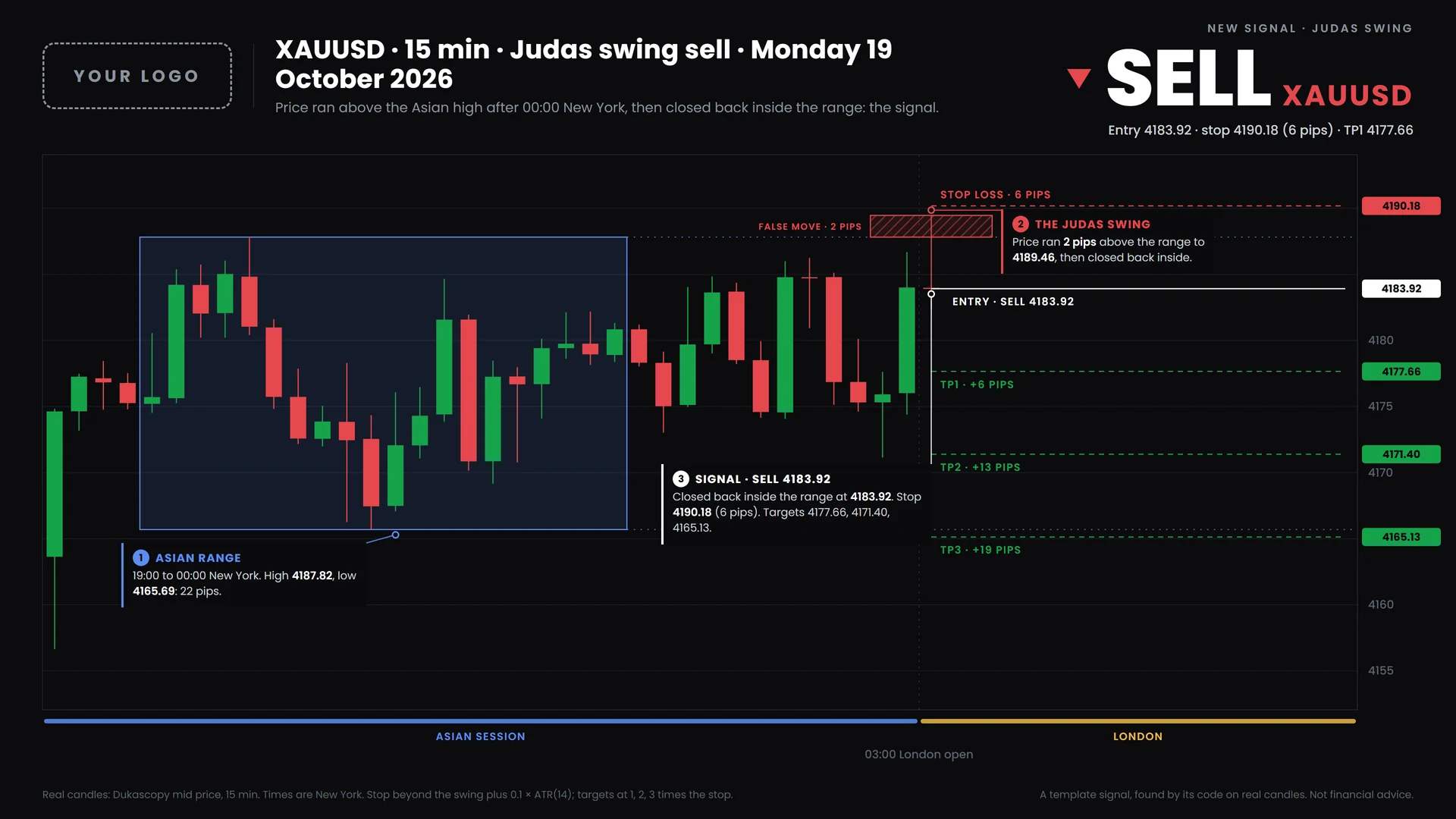
The signal in the chart above: found by the template's code on XAUUSD 15 min candles at . Its levels, and the message the bot would send with the chart:
- Entry4183.92
- Stop4190.18 · 6 pips
- TP14177.66 · +6 pips
- TP24171.40 · +13 pips
- TP34165.13 · +19 pips
🔴 SELL XAUUSD · Judas swing

Entry: 4183.92 (market)
Stop: 4190.18 (6 pips)
TP1: 4177.66 (+6 pips)
TP2: 4171.40 (+13 pips)
TP3: 4165.13 (+19 pips)

Asian range high run through and the price closed back inside. Stop beyond the swing; targets at 1, 2, 3 times the stop.

Not financial advice. Trade at your own risk.
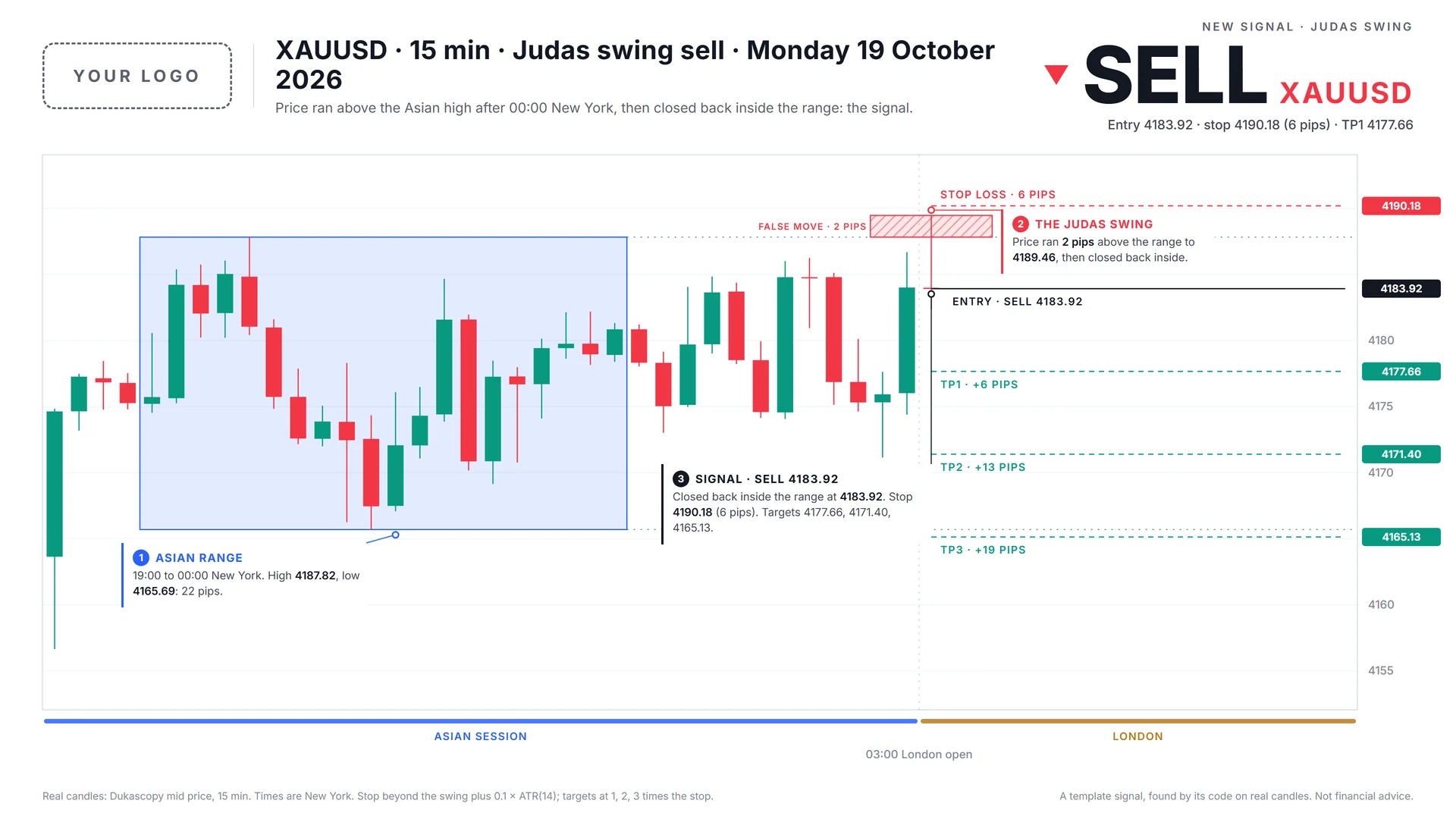
The same signal in another of the bot's chart templates, Daylight, with a space for your logo:
How often it fires
Signals the template's code found with the defaults over the last twelve months of candles. A count of signals, not of wins: we publish no results for templates.
- Gold (XAUUSD)
- 16signals a month: 192 from 2025-10-23 to 2026-10-23
- EURUSD
- 19.2signals a month: 230 from 2025-10-23 to 2026-10-23
Automation, not an edge. A template does the work of watching the chart, finding the setup and posting it. It does not make the strategy win. Before it goes live in your channel we run it over past candles on your markets and show you every signal it would have sent, losses included, privately.
What can be changed
- The rules: every setting above, and any filter or confirmation you can write down.
- The markets: gold and the seven US-dollar majors, one or all of them.
- The chart: your logo where the placeholder is, a chart template in your colours, and the marks your method uses.
- The channels: every signal to a paid channel and a paced share to a free one, the way our own channels run.
Or bring a strategy that is not here: every template started as rules someone wrote down.
Questions
Which Judas swing is this?
The version most often taught: the Asian range is 19:00 to 00:00 New York, the false move comes between 00:00 and 05:00 New York, and the turn has to close back inside the range before 07:00 New York. Other versions use the London open or the 08:30 news time; they are settings, not different bots.
Why wait for a close back inside the range?
A run through the range can be a real breakout. The close back inside is the rule that tells the two apart on the chart: until it comes, there is no signal.
How often does it trade?
At most once a day. It needs a complete Asian range, a run through one side of it between 00:00 and 05:00 New York, and a close back inside before 07:00 New York. On a quiet Asian session the range is narrow and a run through it is common; the page shows how many signals this version gave over the last twelve months.
Does the bot place trades?
No. It finds the setup, draws the chart, posts the signal to your Telegram channel and follows it with a reply at each target and at the stop. It does not connect to a broker or trade any account.
Can I change the rules?
Yes. Every setting in the table above is yours to change, and so is anything else that can be written down: a filter, a session, a second confirmation, a different stop. If a step is a judgement call, we work out with you how to write it as a rule.
Will it make money?
We do not say it will, for this template or any other. A template is automation, not an edge. Before it goes live we run it over past candles on your markets and show you every signal it would have sent, losses included, privately. How a strategy behaved on past candles is not what it will do.
Is it AI?
No. It follows the written rules on this page. The same candles always give the same signals.
Which markets and timeframes?
The seven US-dollar majors and gold today, on any timeframe from 5 minutes to daily. Other markets need a price feed for them first; ask us.
What does it cost?
Templates are in early access: built with you, for your channel, and priced before launch. Early-access members hear the price first. For a broker, prop firm or educator, write to us.
Other strategy templates
Opening range breakout
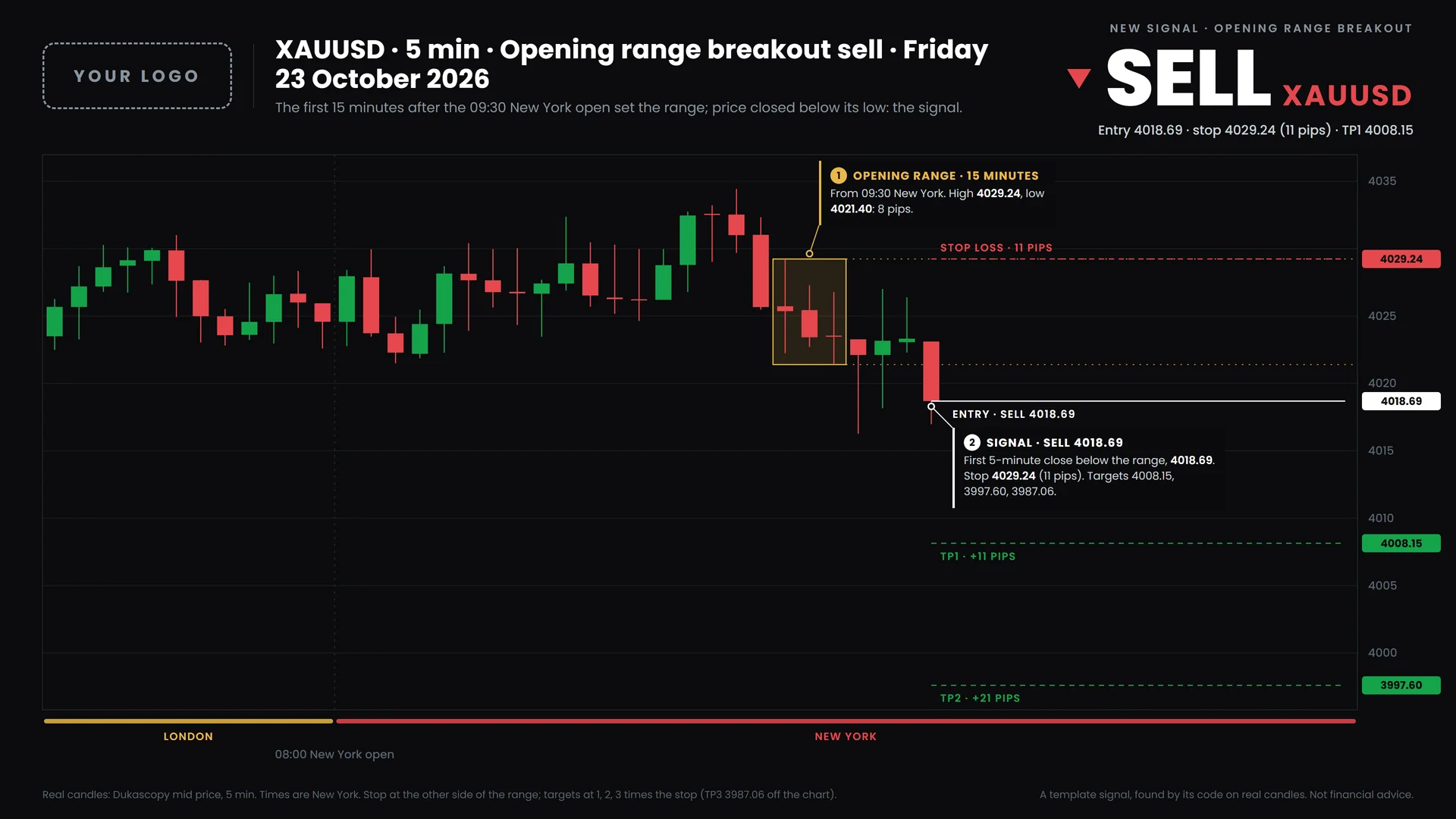
The first 15 minutes after the New York open set a range; the first 5-minute close outside it is the signal.
Fair value gap
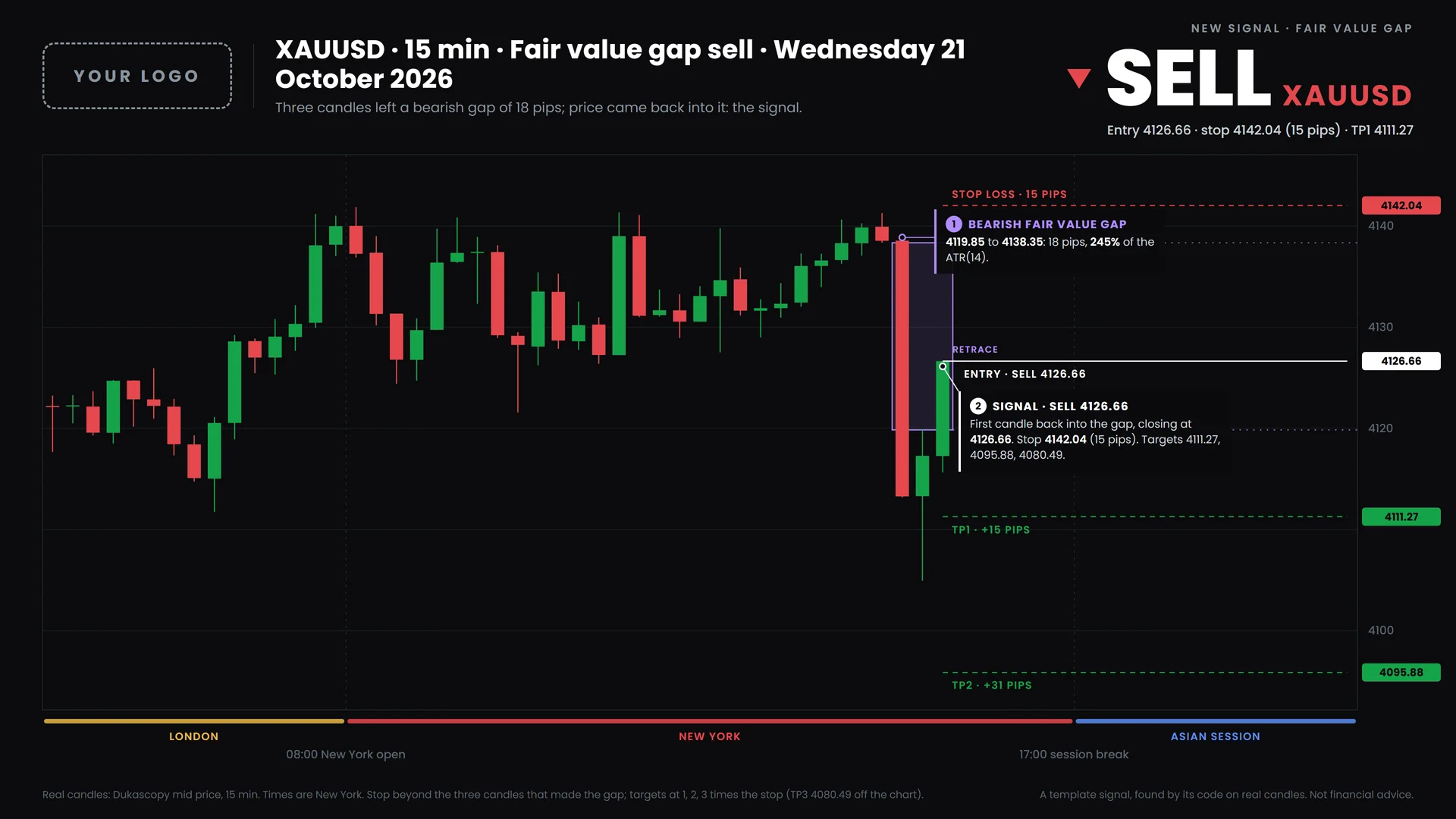
Three candles leave a gap that price skipped; the first candle to come back into it is the signal.
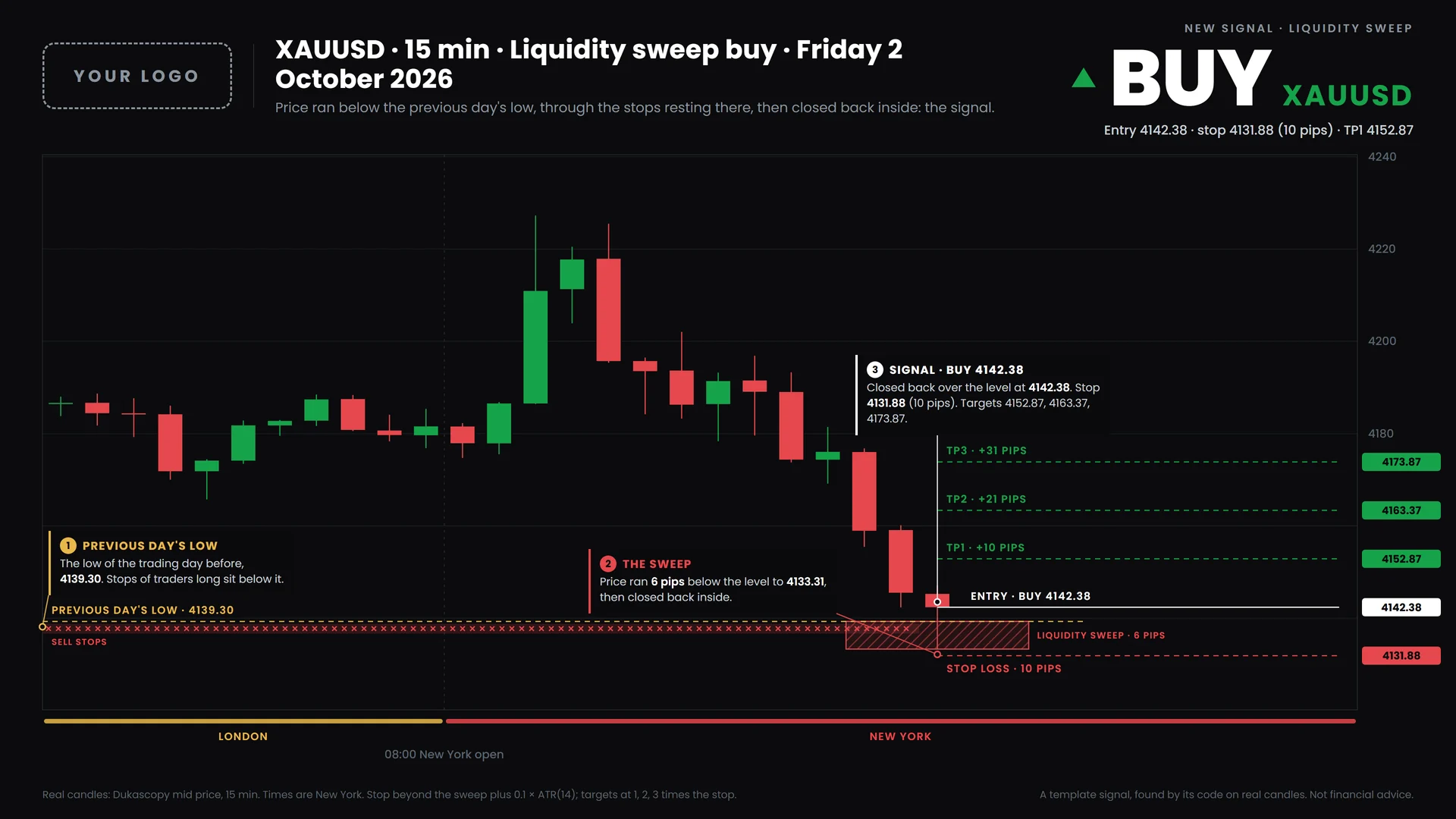
Liquidity sweep
Price runs through the previous day's high or low, then a 15-minute candle closes back inside the level: that close is the signal.
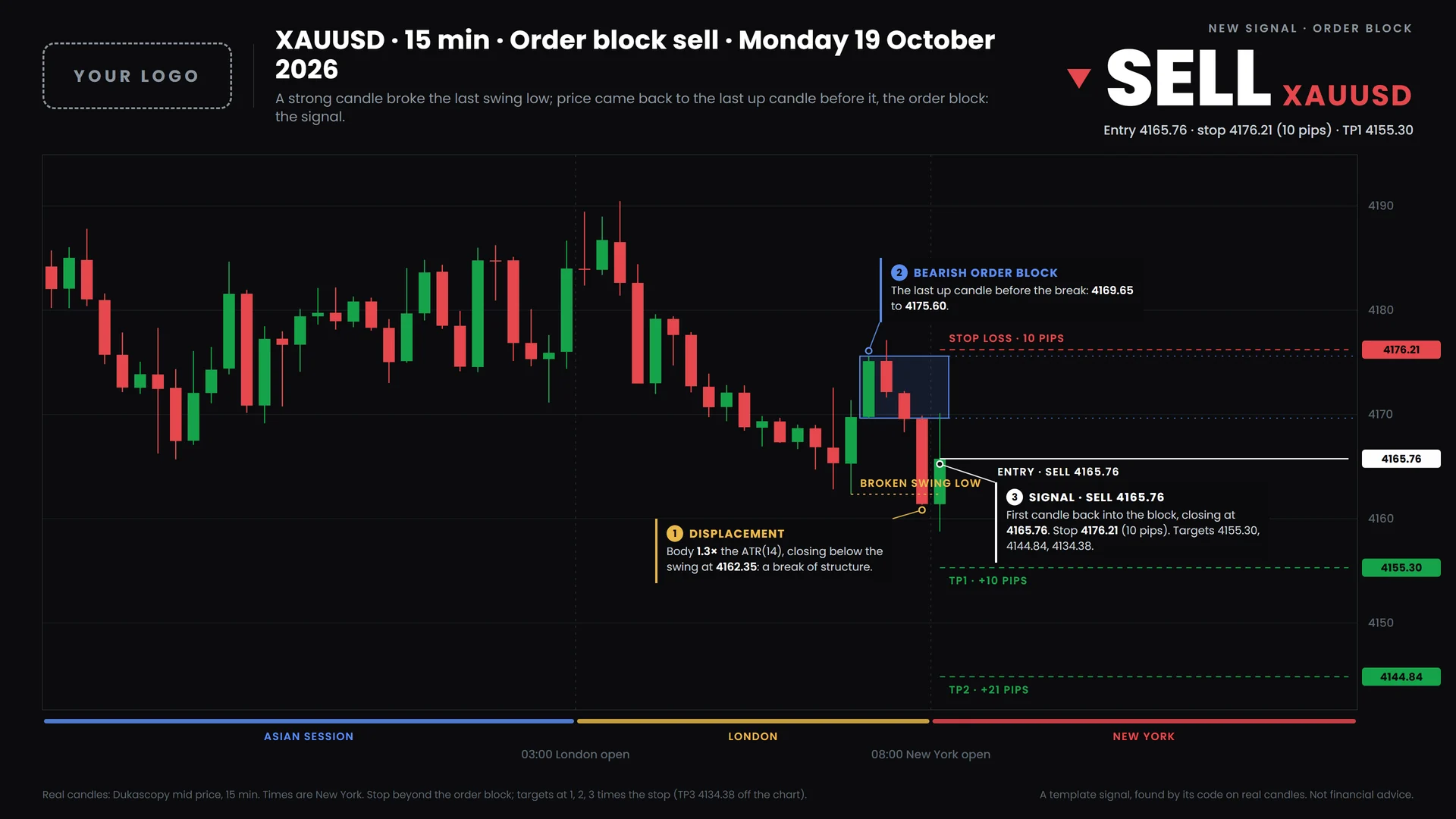
Order block
A strong candle breaks the last swing high; the last down candle before it is the block, and the first return into it is the signal.
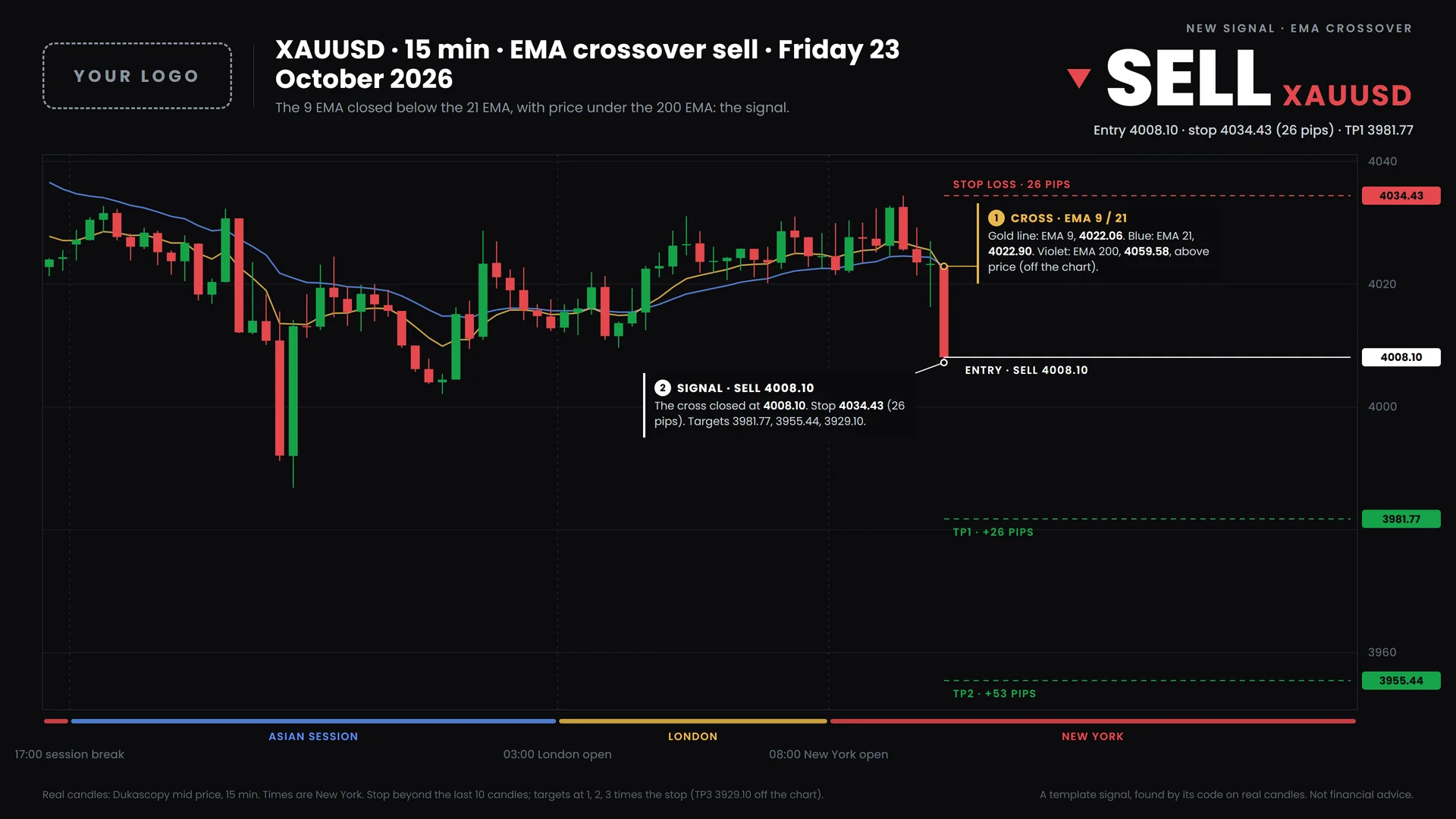
EMA crossover
The 9 EMA closes across the 21 EMA in the direction of the 200 EMA: a buy above it, a sell below it.
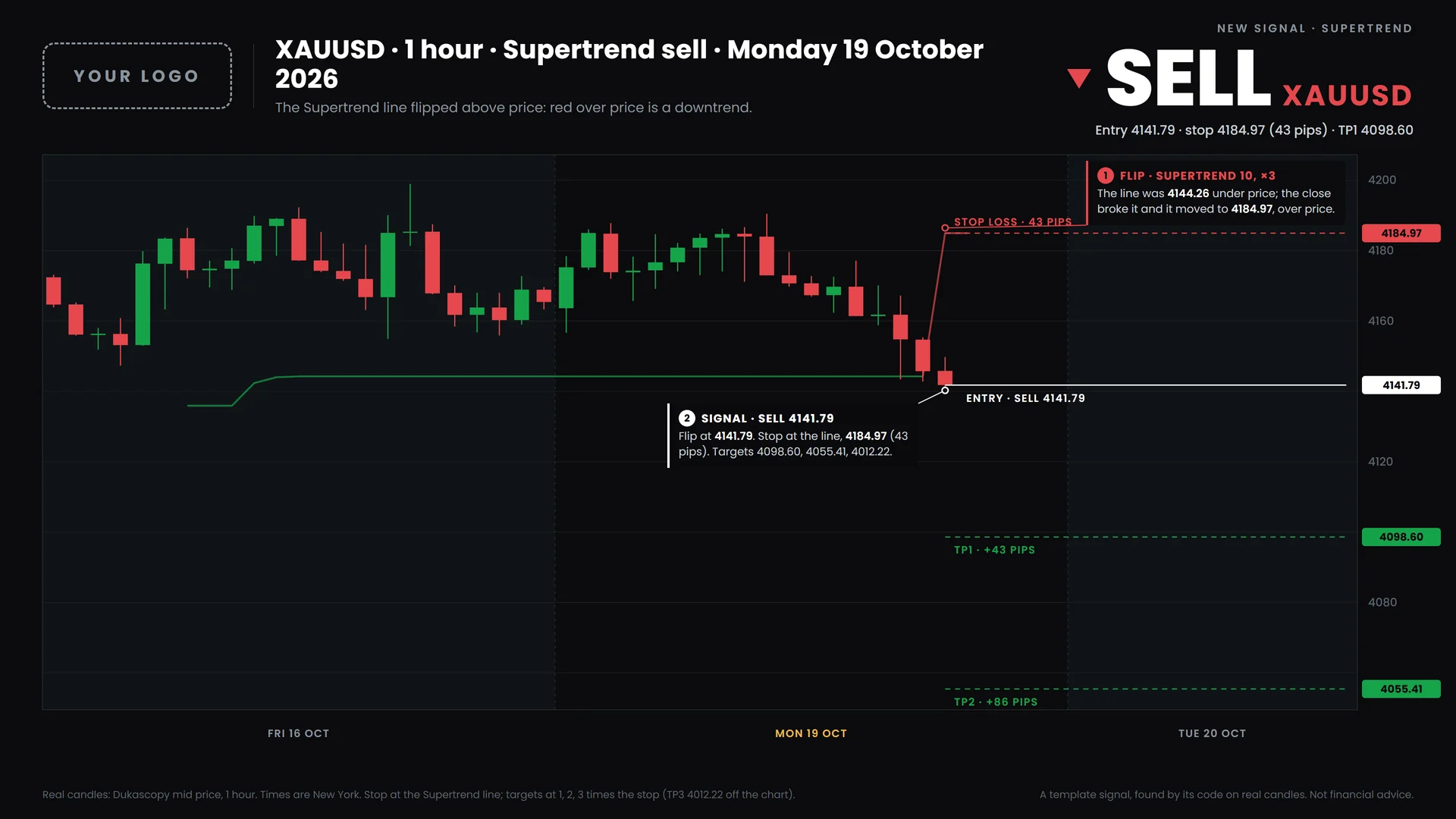
Supertrend
The Supertrend line (ATR 10 × 3) flips from above price to below it, or the other way: the candle that closes through it is the signal.
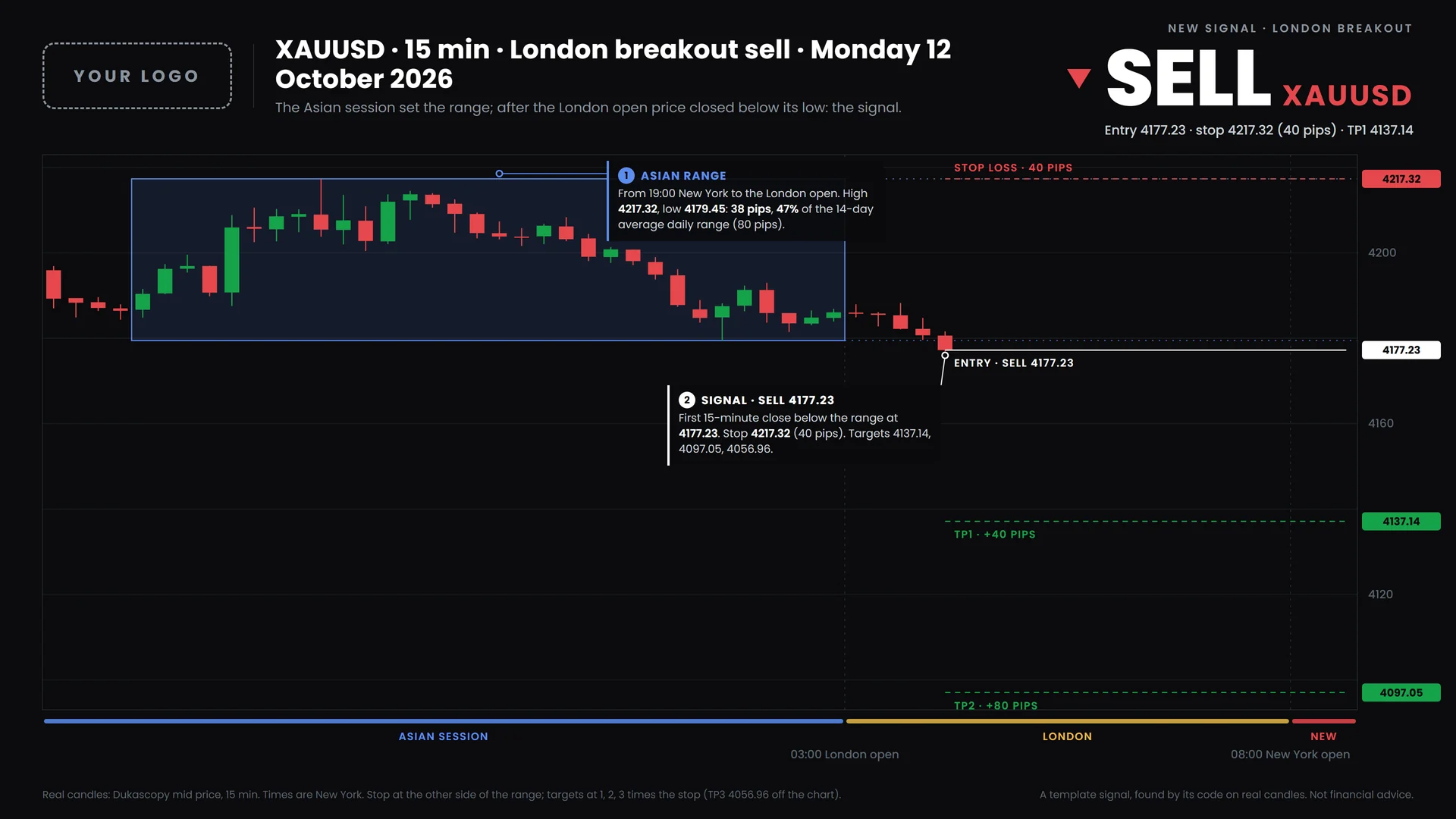
London breakout
The Asian session sets a range; the first 15-minute close above its high or below its low after the London open is the signal.
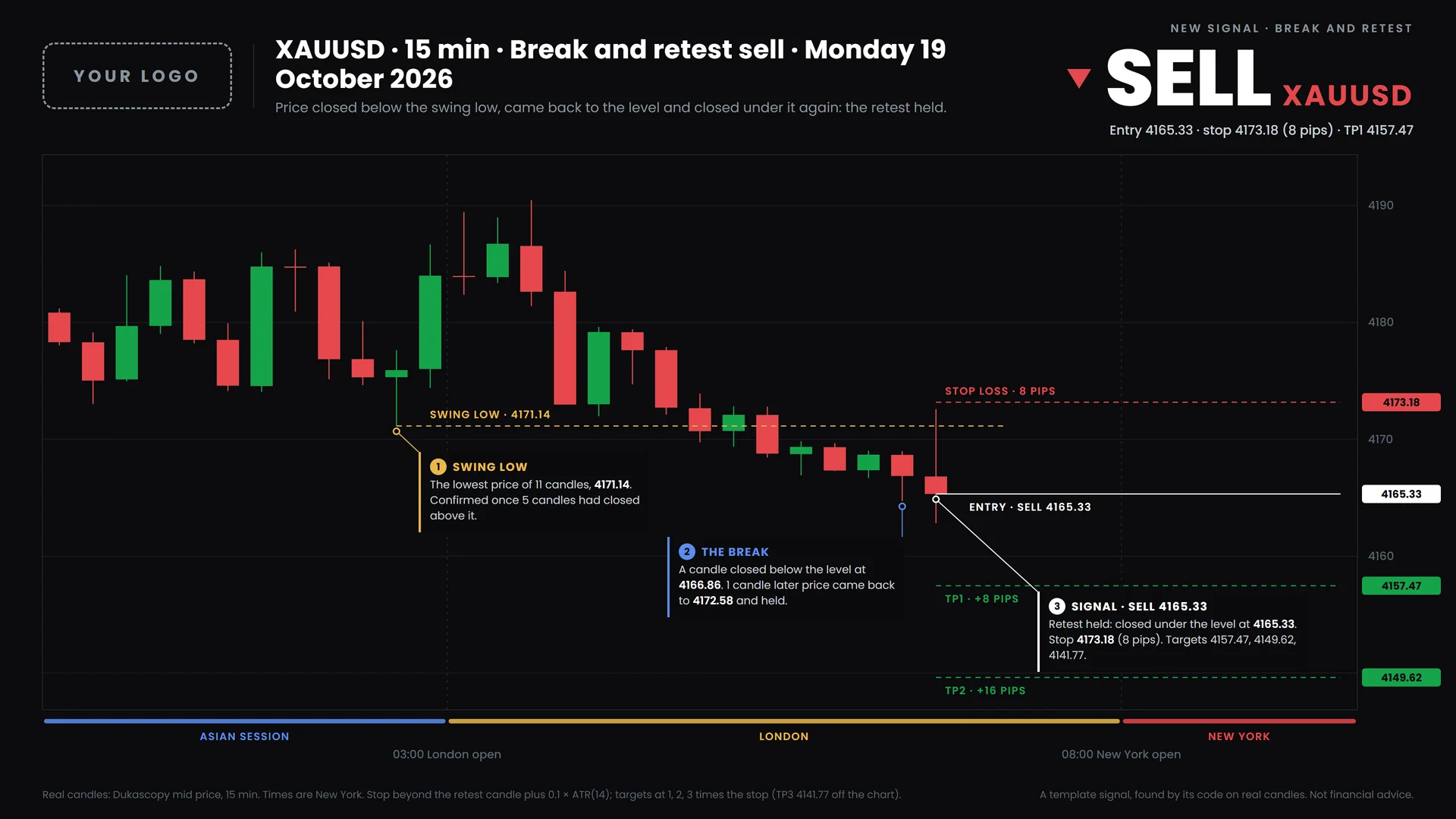
Break and retest
Price closes beyond a swing high or low, comes back to the level within twelve candles and closes on the broken side: that close is the signal.
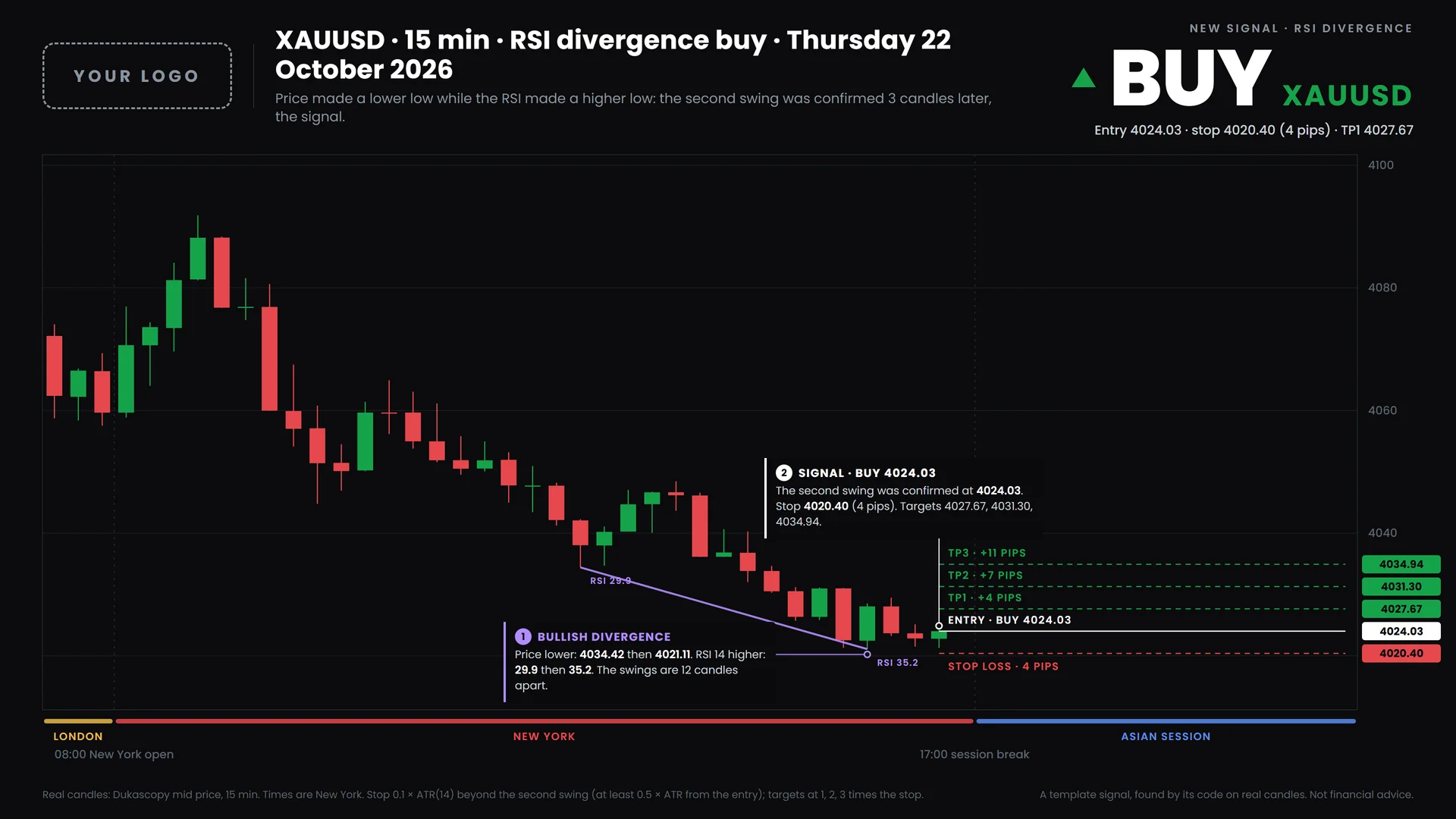
RSI divergence
Price makes a lower swing low while the RSI makes a higher one, the first in oversold territory: a buy once the second swing is confirmed. The mirror is a sell.
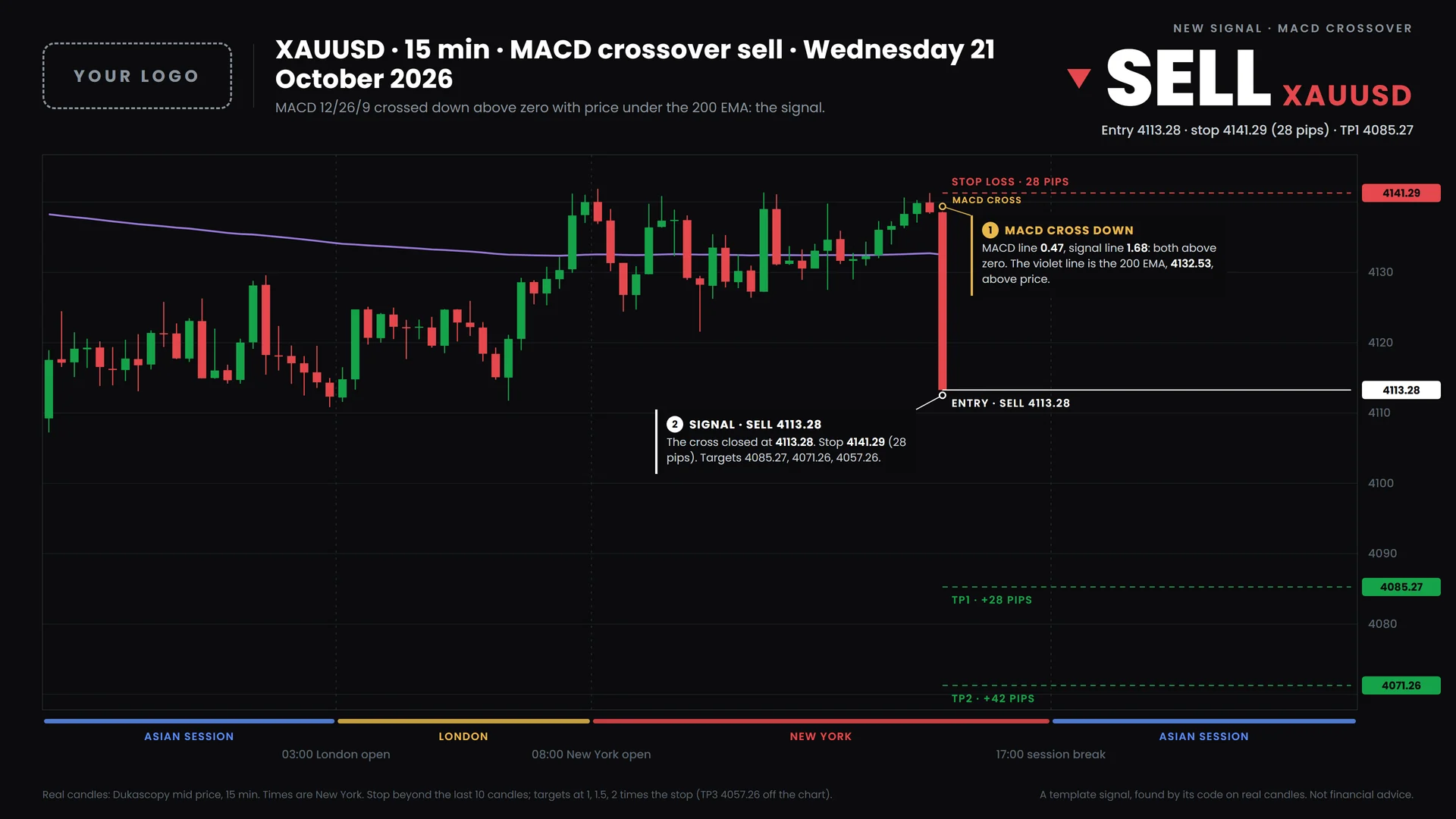
MACD crossover
The MACD line crosses its signal line below zero in an uptrend, or above zero in a downtrend, with price on the 200 EMA's side.
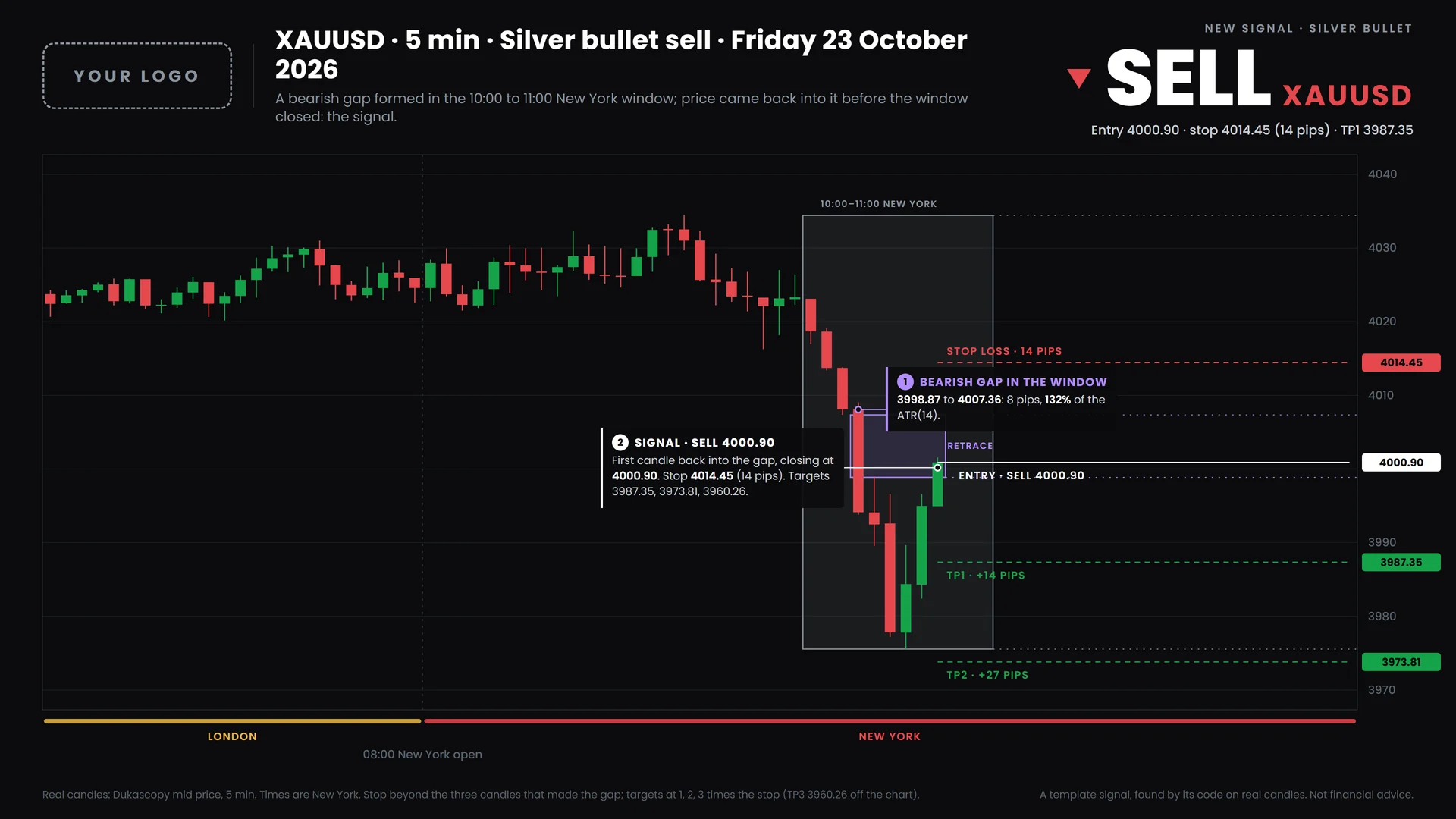
Silver bullet
A fair value gap forms in the 10:00 to 11:00 New York window; the first candle back into it before 11:00 is the signal.